Sunday, October 2, 2022

Flossing the Kenai

 Gentle Readers:

I have repeatedly interrupted my longer than necessary historical interpretation of our Alaskan Adventure with Nike's Rangers in August because I keep going out to chase local fish.  My neighbors count on my disclosure of Dana Point fishing failure because they need to know where not to go in local waters on more of an emergency basis than my readers need another load of Alaskan fantasy.

Well too bad for all of you, as I am now resuming my look back at the freshwater experience we had with Zack Lloyd of Glacier Run Outfitters on the Kenai.  I will have to rely on my memory and overriding feelings about what should have happened on those watery adventures to spin this yarn.

We have discussed our ocean experiences with OFish'ial Charters out of Homer in earlier reports.  On some of the alternating days, we headed back up the highway to Soldatna to join Zack for the unique fishing experience of flossing for sockeye on the Kenai River.

This kind of fishing, explained in a prior post entitled "It's a Wild Northland," involves standing in waders in the unwarm water of the Kenai river with heavy fly gear while backhanding a weighted bare hook about ten feet upstream and relentlessly sweeping it back toward shore with the rod tip just above the surface once it gets about 30 degrees downstream.  If the line is drawn properly and an open-mouth salmon swims into the path of your line, the fish is hooked on the outside of its jaw, often at the extreme end of the rod sweep as the angler is awkwardly twisted back into a full downstream rotation.

The angler's all stand in relatively close proximity to one another in the coveted locations where the fish aggregate in the current before heading further upstream.  Each person is standing slightly over two rod lengths from the most adjacent angler at locations most impacted by the pressure of a consistent run.

This post will once again scramble the multiple mornings we spent, both in separate groups and all together, during several days of utilizing this technique to harvest sockeye salmon, which are the lifeblood of the Alaskan ecology.

Nike's fierce enthusiasm for this kind of fishing is reflected in the guide and time table she chose for us.  On the first day, after Ajax, Dionysus and Paris opted to sleep in, Nike, Penny, Isaac, Archimedes and your reporter took the early shift with our guide Zack at a marina slough a very short distance from the prized location where we would start our nocturnal wading.

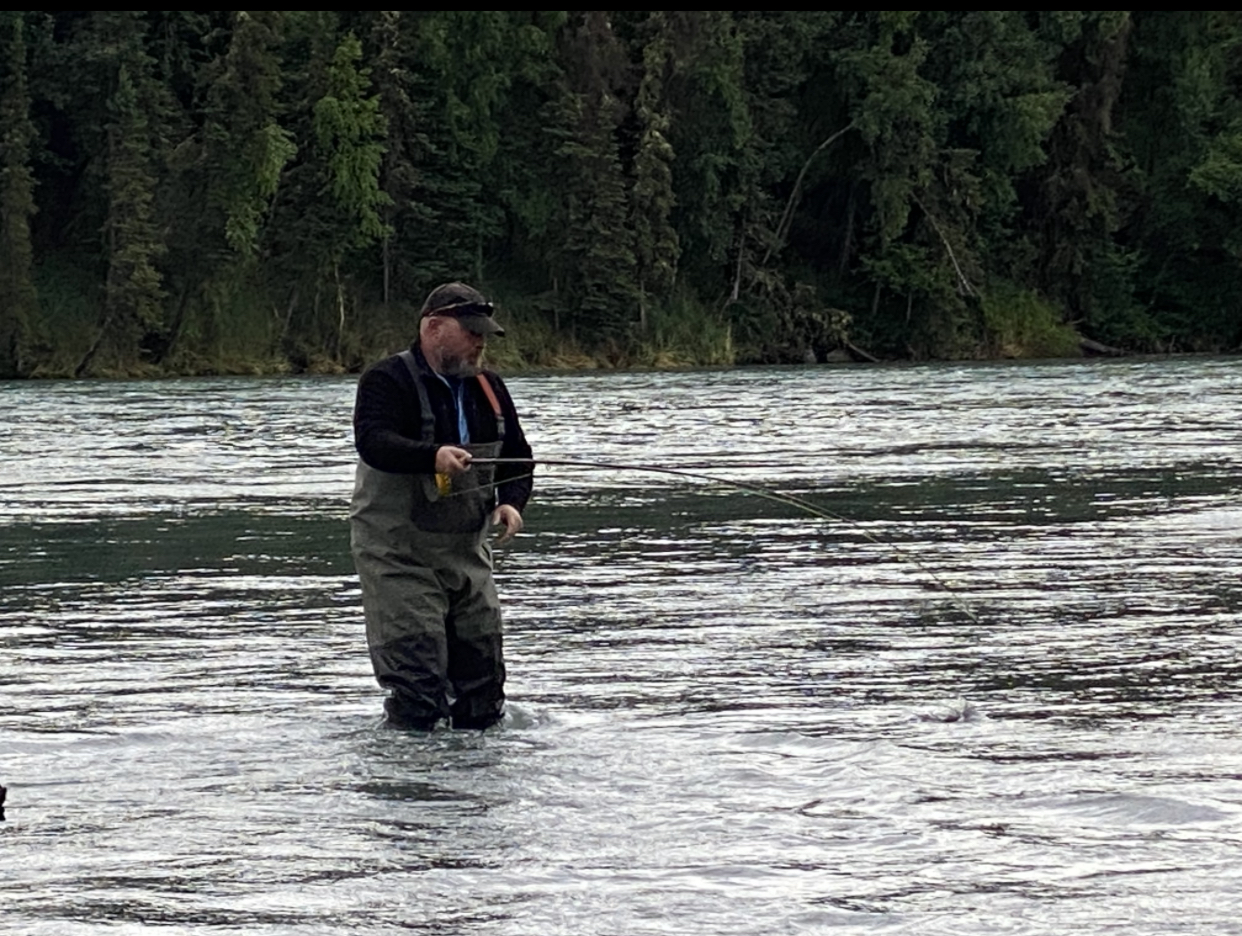
After a night of  beverage-informed enthusiasm, the late start guys seemingly had the advantage of potentially getting a fair night's sleep. The volunteers for Nike's forced march piled into the van just after midnight to drive back up to Soldatna to make sure we could put on our headlamps and gear in Zack's river sled at 3:30 am.  We had to be the first ones to wade out into the current, taking cautious steps in the slippery darkness to stake our claim for a good spot, like bears.  Your reporter did not chance many photos in the dark, but did get a few in the emerging dawn.

On the highway, we encountered a  truck stopped in our lane with its engine compartment on fire.  The driver, who appeared to be a grown man, was on the phone with his mother, offering to take full responsibility for whatever had just happened to bring him to this unhappy situation.  It was one of the few times during our trip when it was not raining, which was bad luck for our motorist.  He had used up whatever liquid he had and the fire had swarmed back up in his opened engine compartment.  We used the entirety of our day's water and beer supply to douse the flames, while our nervous motorist scampered a short distance several times into the woods to complete undisclosed chores.

We got the fire out by the time we turned the scene over to the state trooper who fortunately responded rather quickly to this middle of nowhere spot.  We assured the officer that the empty beverage cans did not represent anything that the driver had consumed, although we privately discussed the strong possibility that he was influenced by the mysterious forces of chemistry before we came along.

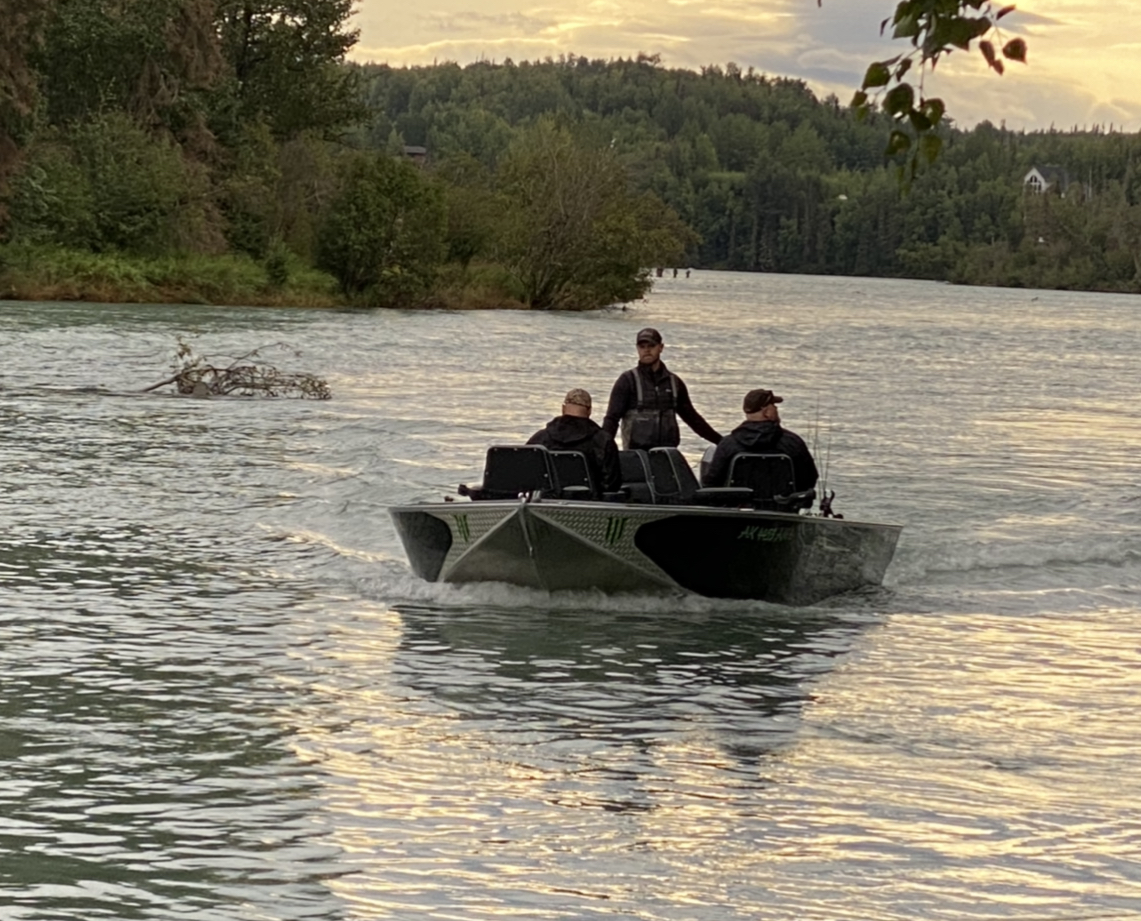
Our  good deed for the day accomplished at an early stage of that day's activities, we proceeded to our rally point at a trailer-boat marina on the Kenai.  It was a very short boat ride to our spot on a bar where we stumbled out of the boat and cautiously edged out into our positions along the river while wearing headlamps and rain gear.


Setting out at 3 am on day two of the Kenai, Archy and Dionysus manage broader grins than your reporter at the momentary lack of rainfall.

We fished in the darkness for several hours, mostly to stake out the prime spot.  Other groups of anglers came along once it got closer to daylight.  The fish are even closer to shore in the dark and we were handcuffed by a few takers that were swimming right next to our boots.  

This year's sockeye run had been stupendous, so the  daily limit was raised to 6 fish. The last time we fished the Kenai, the limit was three and they did not taste as good as this year's run. An angler can also take silver salmon, for which the limit is two.  Many of the fish we actually hooked were pink salmon, which are generally considered less than prime and are released after a spirited  fight. 

The fish were in various states of their spawning changes, including this beautifully humped specimen (a pink) caught by your narrator and displayed by Zack before being released to pursue its suicidal mission to soldier upstream and ejaculate.

Getting photographs in the rainy rushing waters was a challenge, as a wet phone is easily lost in the slippery darkness. Dionysus discovered this early into our trip, resulting in his being deprived of his cell phone for the duration of our adventure.  This was a handicap he did manage to overcome, but it was certainly a lesson for all of us.  It tempers one's enthusiasm for fighting through rain gear to snap an action photo while trying to maintain balance, hold your fly rod in your mouth, find the button and get a shot of someone else catching a fish while trying not to step on a salmon carcass or trip over a snag.  Several anglers, including Nike, ended up falling into the river just trying to move around while fighting fish. 

Your narrator nearly went down at least a dozen times while slipping on carcasses washing downstream, backing into snags while fighting fish, or just trying to get into a good stance to brace against the current.  

Penny caught several fish, but periodically climbed back into the boat to give her numbed feet a chance to warm up so she could avoid falling in the cold waters. 


One never knows what is striking the hook until it is brought to bay.
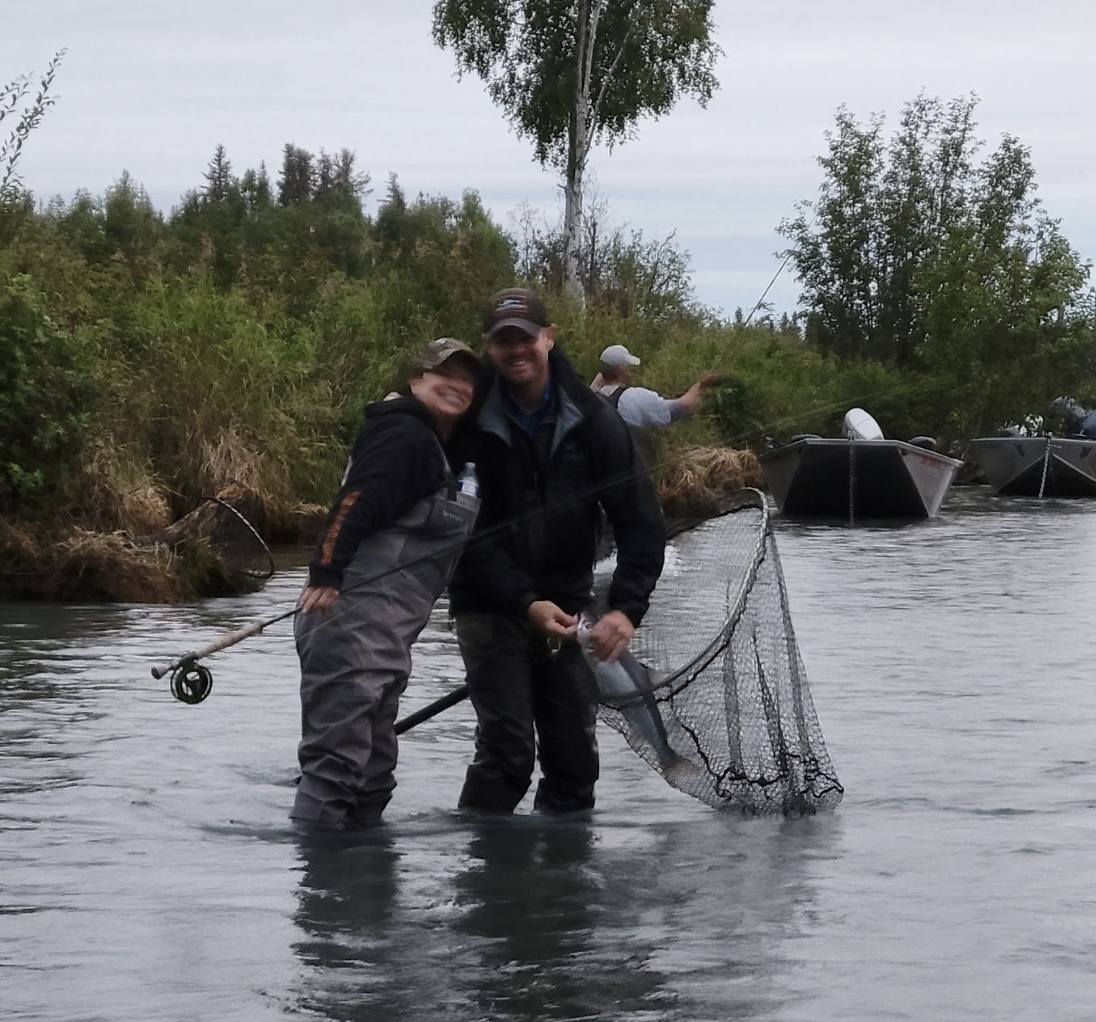
In the photo above, Penny gives a smile from behind a monster salmon Isaac was there to photograph.  You can plainly see that this youthfully optimistic fish is as long as her arm, but Isaac released it anyway.

Penny did not fall, but Nike counted among the fallen because of her take no prisoners attitude in running about in the shallows to chase fish that try so hard to make the most of the short life they have left.

On the first day, we all did great in the morning and were rewarded for our early start and good samaritan highway work. Later in the morning, we grew thirsty as a result of our fire-fighting efforts, crying like British soldiers for Gunga Din.  One dared not sip from the waters we fished, as they were well seasoned with decaying salmon carcasses. The afternoon crew did not fare so well, causing Paris to question the value of standing in the rain for hours while catching nothing. He limited his remaining fishing activities to one ocean boat ride before fleeing for home midway into our trip when he found out we were going flossing again. He threw a rock through the front window with a note tied to it that read "Salmon flossing is bullshit" before hitch-hiking on the moose-meat wagon that makes its daily run to the Homer airport.

Paris and Penny in happier times on the ocean before he went AWOL

The morning fishing was fantastic, especially after the first few hours of standing in the dark and trying not to fall gave way to daylight.  Zack was kept busy running through the rapids with his net to harvest or release whatever the members of our group brought in. The species was not always ascertainable until the fish was in the net.  The fish often ran back behind the line of fisher folk, jumping and zig zagging along the line.

Our group was large, so the fearsome duo of Ajax and Dionysus were set up on our most upstream point of our picket line to scare away interlopers. Their  rods were both on fire, catching many fish at a point where the river took a bend above a fallen tree.

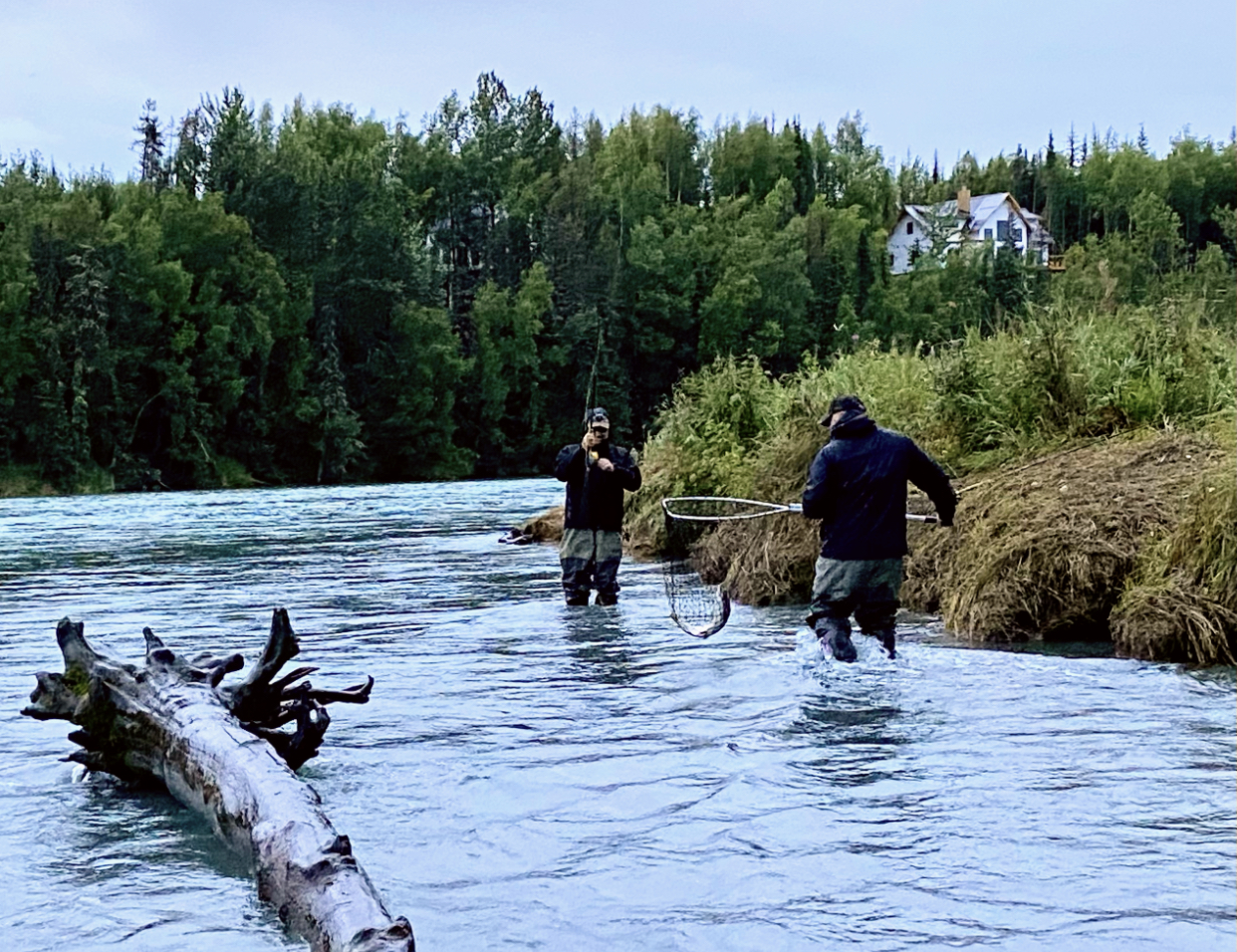
Because of the distance, Zack soon gave them one of his nets so that they could capture each other's fish, as he was worn down by having to run upcurrent so many times to snare their countless hookups. 

I was posted next to them and so got several pictures of their frothy hijinks after I cautiously retrieved my phone out of the flapped pocket of a fancy new Aftco rain jacket that proved to be less waterproof than I anticipated, as the constant rain eventually soaked through. Below, armed with the net Zack left for them, Ajax thunders through the extended shallows toward another of Dionysus's victims.

Allow me to continue my bitter review of my outerwear, which I finally broke down and bought to replace a twenty-five year old faithful servant that was no longer keeping me dry.  The new jacket, misleadingly named the Hydronaut (Hydro Not?) fits great and has really cool pockets, but is more water-indifferent than water-proof.  I could not return it because I learned their policy is that all returns must come back unworn and with tags still attached. I did not see a lot of other guys wearing jackets with tags on the Kenai, so bad on me.  I intend to buy some waterproofing spray to enhance its ability to repel water, which is roughly on par with a former reality TV host's ability to leave top secret documents where they belong.

Penny brought a nice sockeye to Zack's waiting net before getting back into the boat to regain circulation in her feet.  Nike and I both caught this moment in a crossfire of camera work.

While Penny was in the boat restoring circulation, she took this quality photo of Isaac with a nice silver, which I think are the best fighters.

Nike and Zack took a break after Zack's splashy charge through the shallows to capture another sockeye.

Zack displays another quality specimen. 

Isaac demonstrated the proper technique of backing toward the shoreline, arcing the rod toward land and leading his feisty victim upstream to Zack's waiting mesh.

Dionysus tugged on one of the many fish that tried to take him under the horizontal tree that was his nemesis at that spot.  Ajax managed to dig it out to add to their pile.


Zack had to ferry Ajax and Dionysus back separately during daylight hours because their size exceeded his boat's capacity, which is not something anyone notices at night.
We all got back to the dock at the end of each morning to hang out and get some poses in with our  painstakingly arranged daily body count.

Isaac crouched next to our more careless pile from Day One.  Several of these fish bore large bite wounds from the gauntlet of seals at the mouth of the river.  Some of these did not seem survivable, but they made it as far as our spot on the river. Thus, their brave perseverance was ultimately futile.

Nike and Penny got in the mandatory girl-and-guide photo


Your reporter and Isaac snuck in a similar shot when Zack had his back turned at the cutting table.

Isaac and Nike cooled off in the misty rain while Zack continued to perform the wet work with the speed and precision of a samurai.

We felt like we had put in a long day when we left, but the truth was that we were done at 8:30 in the morning.  This afforded us the opportunity to have breakfast at Ginger's, which turned out to be one of my favorite places to eat on this trip.

The food was really good and the Rock-n-Roll decor was fabulous.  It is located in a deserted mall in Soldatna that is a throwback to another era.


The mall features dreamy artwork depicting the spirit and elements of the Alaskan ecology.


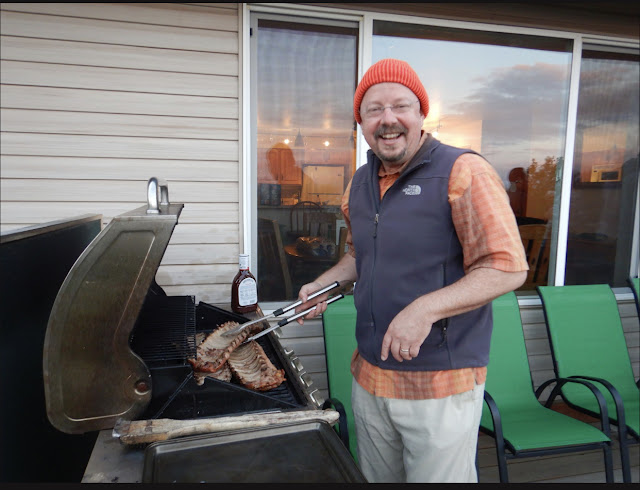
We usually stay away from eating what we catch on a fishing trip, preferring to eat land animals, such as the pig that used to own these ribs expertly prepared by Archimedes.  Many people do not realize that pigs can grow a new set of ribs faster than a lizard grows a new tail.
Nevertheless, Ajax did prepare a fabulously delicious meal for all of us from a silver that Penny caught and donated to the cause.
We enjoyed a few fun nights out, although on this occasion the table your reporter shared with Penny was invaded by a Kilroy-like intruder.


We made the most of our early morning finishes to walk about the town and check out all it has to offer

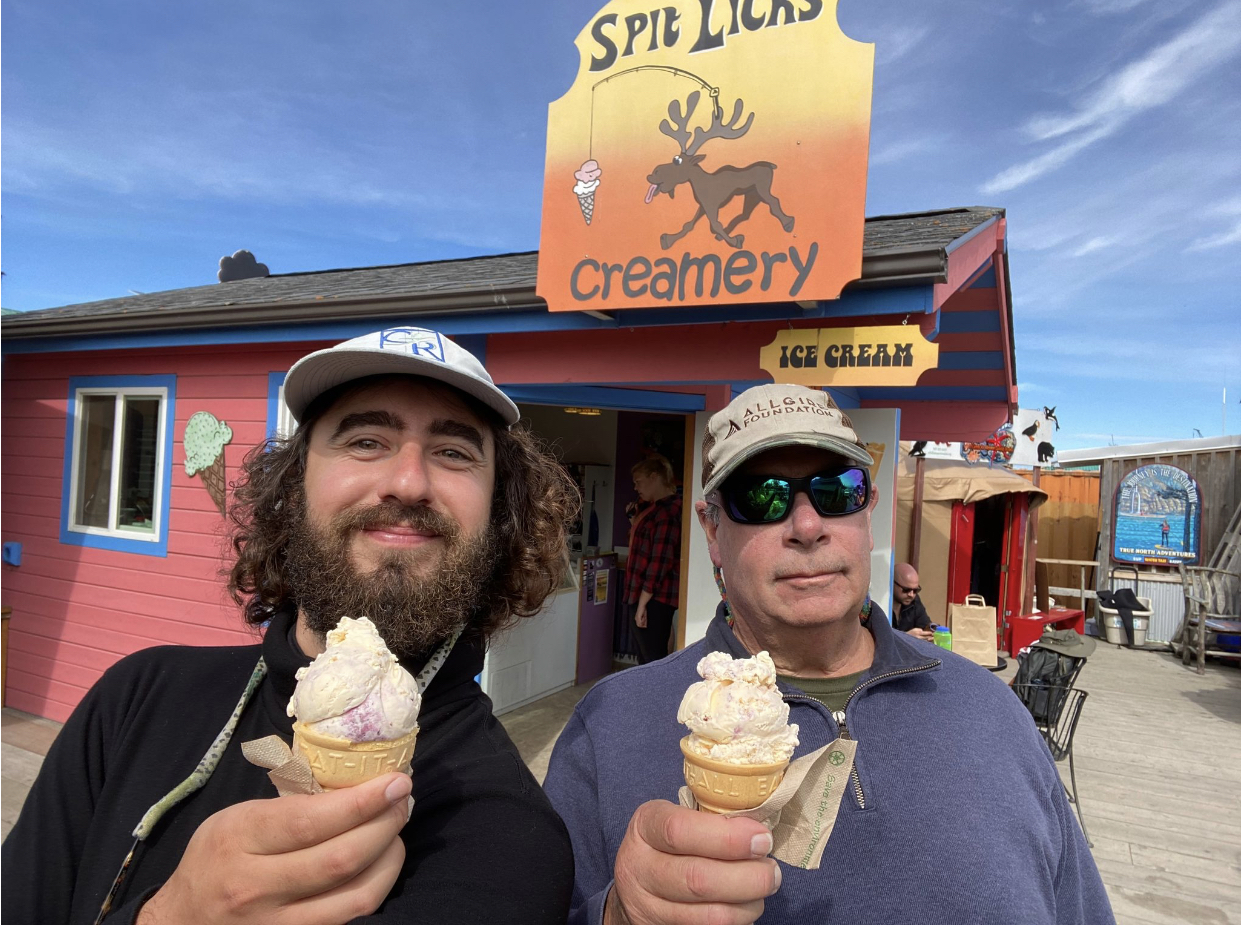
When the sun came out to start baking us, I even got the chance to buy my little boy an ice cream cone at the crude, yet appropriately  named Spit Licks creamery.
I still owe another Alaskan report about the Kasilof, as well as the tragic day of salmon trolling that occurred when Isaac and I were abandoned to the exploitation of flim-flam farmers from Minnesota, but I will leave this patient readership with the image of Nike and Penny demonstrating for social media how to consume alcohol and provoke a charge from a mother moose guarding its calf.  As even stupid animals know,

These are the Days


Knife jigging for Tunettes

On September 30th, Isaac and your reporter joined Secret Skipper to head out with the rest of the fleet past Catalina Island to yank jigs all night again for the big bluefin other people keep catching.

We left Pedro at 5 pm, picked up a scoop and a half of just shoot me sardines from the hospice pen and headed out in cranky chop to set up just after dark.

It was windy so we used the 400 gram Mustad knife jigs we upgraded with larger assist hooks and 200 pound leader.  We constantly rejuvenated their luminescence with a blinding TV- advertised flashlight that is so powerful that it produces recoil, even after you freeze it in a block of ice and repeatedly drive over it in a huge pick up truck while your neighbors call the police.

We changed location constantly as we chased meter marks around in the backlight of the fleet over many square miles.  Many long range sport boats were out there with us, along with a few small boats like ours.  The zones we explored got progressively more crowded and the seas eventually flattened out quite a bit.  Several boats got fish, including the "small ones" in the 50 pound class, as well as the bigger ones over 100.

We got neither of those.  Shortly before gray light, after another exhausting night of jacking our handles, we hit a pile of promising marks and got some biters. By that time, the improving weather had allowed us to change out to 300 gram jigs. The fish barely fought back against our heavy gear and we boated three in short order.  They were bounceable with the gear we had, but we gaffed them out of our sense of ceremony.   We bled, gilled and gutted them to get them in the kill bag and buried in ice right away.  Their dainty size made our ice supply look impressive.  

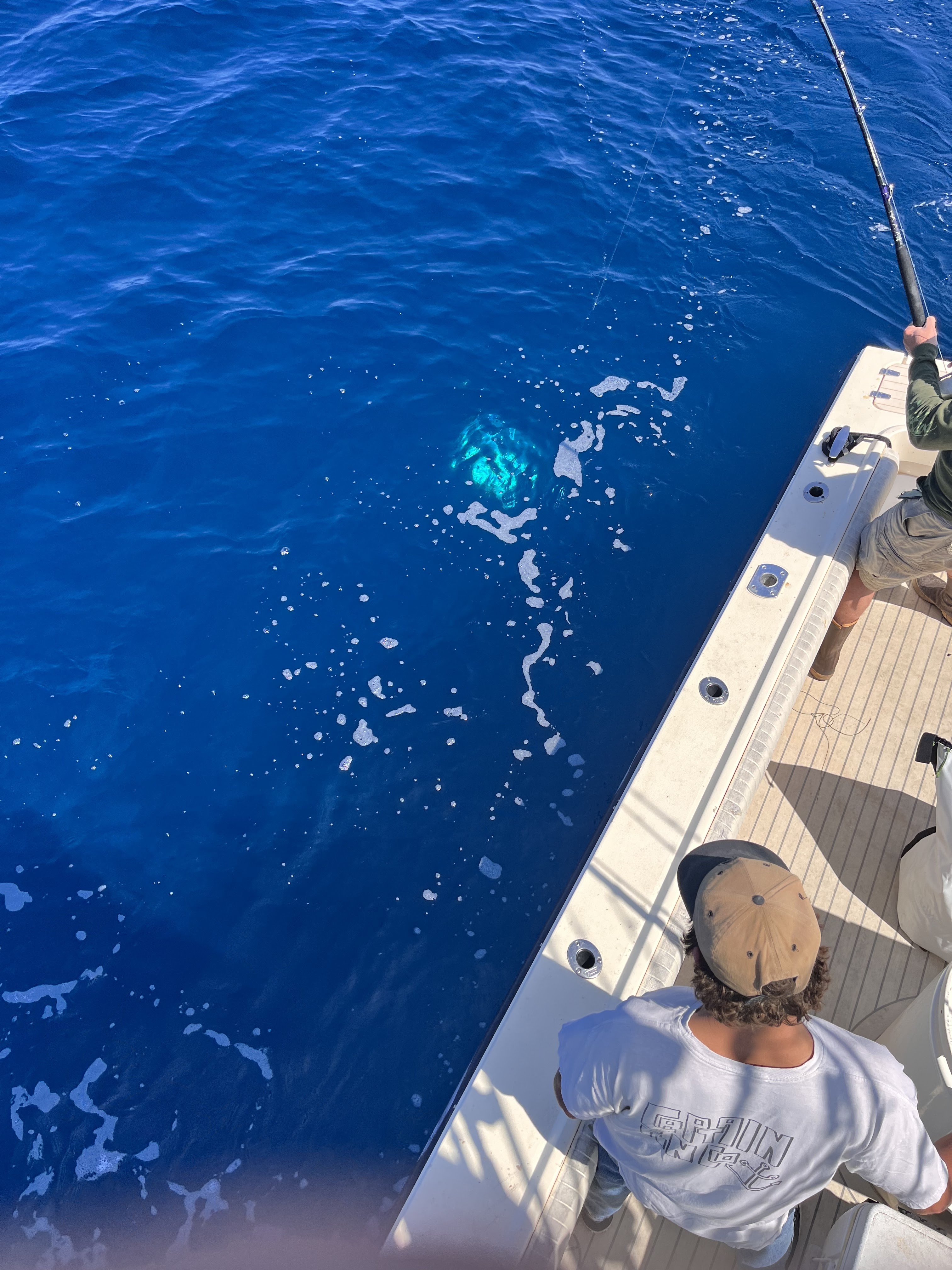
They were all about 20 pounds and were the smallest bluefin we have even heard of this year. I have no action photos, as we all hooked up at once and the rods didn't bend much anyway. We were grateful we still had a few spots left for the giant ones to fill out our limits as we watched the sun come up.  We planned out finishing out the early morning by dragging the Nomads around once we had sufficient visibility to put them out 350 yards behind the boat.

The sky was cloudy and stayed that way all night and into the part of the morning we stuck around to see.  Sea temps were 67- 69, noticeably colder than what we found last week when we did the same thing for no tuna and ended up salvaging the day fishing yellows at Clemente.

The ocean grew positively glassy.  We got one hook up on the mackerel pattern Mad Mac.  We kept the boat in gear to make sure that we maximized our chances for a double hook up. Instead the fish let go after about five seconds, even though your narrator furiously reeled in the diminishing hope that it was a huge tuna charging the boat.  That proved to be the highlight of our trolling adventure, though our striping the ocean continued another three hours until about 10:30 am.

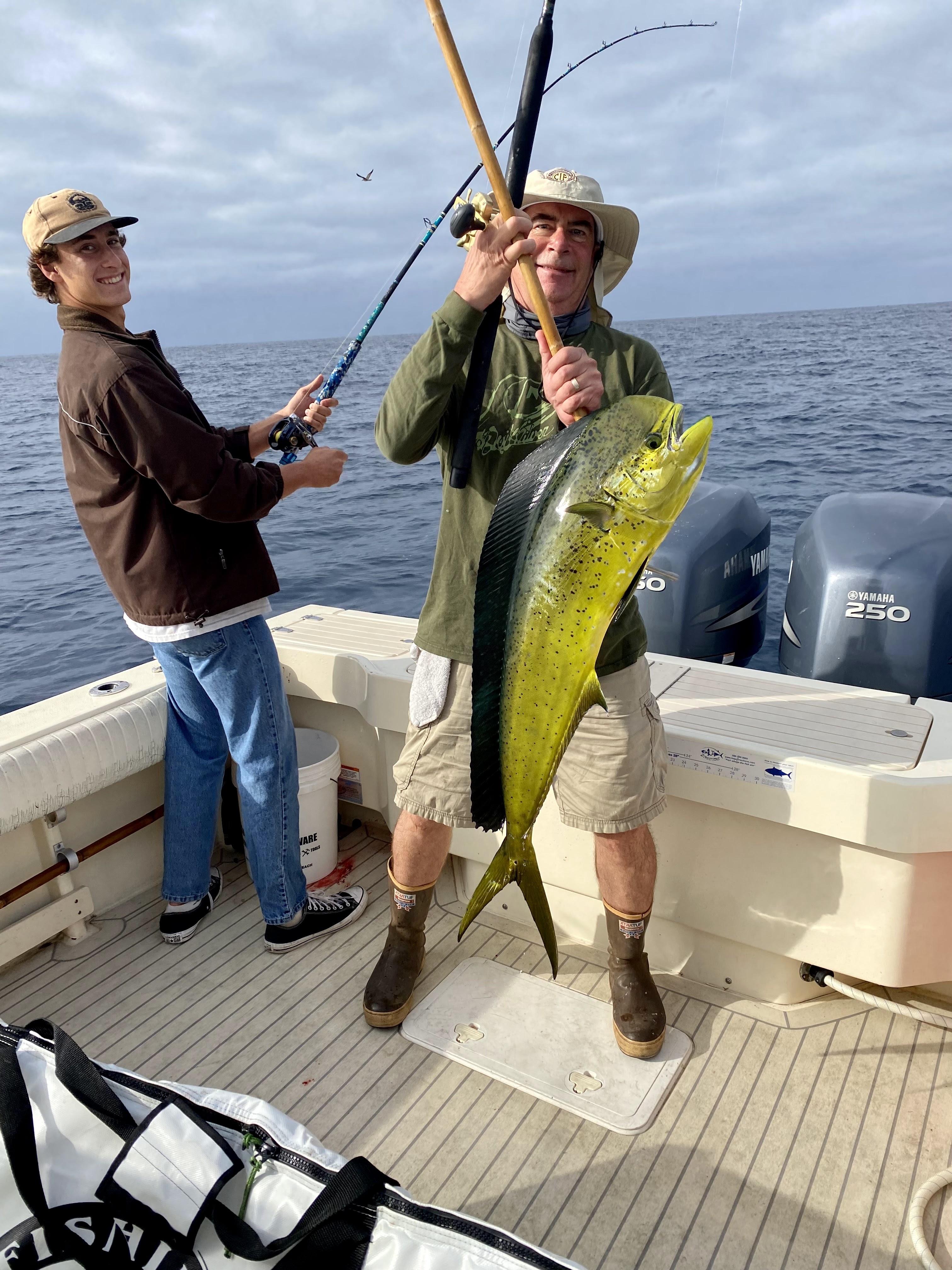
Around 9 am we stopped on some free swimming dorado we spotted well off a nice paddy.  Skipper was the only one ready with light gear and he tossed on them as we slowed down for his cast.  He got his fish to color before we could winch-monkey both jigs back into the boat, which Isaac interrupted doing to gaff Skipper's fish. The dodo was long and skinny, but mostly skinny.  We rolled  back up on the paddy that was sparkling with jumpers, but could not get any of our gummy takes to stick.

We passed off half of our remaining moribund dines to some friends in another boat.  Their bait had rolled just before ours completed that process.  They had caught a couple of nice tuna during the night and expressed their congratulations to us about catching three, until they learned how small our fish were.  At that point they kind of stood back and moved away slowly, trying awkwardly to avoid embarrassing us by looking directly into our eyes.  We did not let them see our fish, but pointed at the kill bag, bulging like the Michelin Man with its bountiful supply of ice enveloping our pygmy prey.


We had obligations that required us to leave the grounds by 11 am and we had a smooth 32 mile an hour ride home.

An exhausted Skipper meat-axed our well-chilled prey on the way home, so we all have some nice sashimi for watching football and feeling sore today.

The sky was cloudy and stayed that way all night and into the part of the morning we stuck around to see.  Sea temps were 67- 69, noticeably colder than what we found last week when we did the same thing for no tuna.

The ocean was actually very fishy, with yellowfin on some of the dolphin pods and many good bluefin results for people with more talent than we bring.  There were several spots of tuna-chasing dolphin crashing around in calming water, so it is still on out there and probably going to get better before it goes away.

We made it back to the harbor and were unpleasantly surprised that prices at the fuel dock had jumped over 20 per cent since we gassed up less than a week ago.  $7.50 per gallon may do more to keep us at home than the mediocre results we have achieved dragging these jigs at the least efficient speed that most boats can deliver.

If you are small and weak, the good news in our scouting report is that there are now bluefin available that everyone, including small children and old people, can get over the rail.  

On the way in, we dodged the newly planted lobster pots mining the harbor entrance at Pedro light.  It was a reminder of the season opener and the fact that we now all have an opportunity to load our cages with pelagic carcasses and chase bugs.  This will be more economical if we bring oars or rig sails, but the notion of lobster, bluefin and dorado in the same trip is a pretty cool (and achievable) fantasy.

Get your gear dusted off for that incredible triple fantasy while you can, because

These are the Days


Sunday, September 25, 2022

Ozzy and Chariot

Gentle Readers:

With this essay, I promise only brevity in place of quality and I'm lying about that.

Friday, after your reporter left the exciting CLM construction law seminar  in San Diego to get a jump on the weekend's plan for carnage, Secret Skipper took me out for a nocturnal mission that matched delusion to reality. Our plan and destination was all night knife-jigging for bluefin at the Osborn Bank.  We had big gear and big plans for big fish.  We left the dock early with many ice chests and lots of ice.  We spoke of breaking out the pressure cooker to can those 200 pound  fish we could not accommodate by eating, gifting or freezing.  We might have to work all day Sunday and take off Monday just to get it all processed.

We procured two very generous scoops of large and sluggish sardines from Mike at Pedro Bait company at 7 pm and proceeded through surprisingly calm seas to arrive on station at the Osborn by a little after 9 pm.  We noticed the glow of the fleet on the backside of Catalina on our way out.

There were few boats on the Osborn and we jigged on our giant gear for a couple of hours of nothing and no marks before deciding to head toward the light in the distance like squid do.

We joined the fleet, which was about 15 miles away, to tediously reel up and drop down amidst a host of sport boats doing the same thing for mostly the same results, all night long.

At gray light, we decided to head toward Clemente instead of Santa Barbara Island and look for paddies, dorado and maybe some of those yellowfin that had moved in to balance out our catch of pelagics.

We made it to the west end early in the morning and saw lots of bird action and breaking fish.

Skipper hooked up to what seemed like a small yellowtail.

As it turns out, it was a Laguna Tuna that we released instead of converting it to lobster bait for the upcoming opener.

Compare and contrast it with another rider that had so recently occupied the deck of our vessel.

Skipper got another quality bonito that, had it been a yellowfin tuna, would have qualified for a 12 pound class caption in Western Outdoor News.

It was neither of those things.

Your narrator also got in on the action with the bonito and barracuda, but could not hang a yellowtail.

Skipper eventually found a quality resident yellowtail that fought him up and down the water column every step of the way before your reporter got the chance to plant the gaff.  He weighed over 26 pounds.  It would have been our preference to forego this measurement and lie about the size, but we burdened ourselves by bringing a scale.

We should have taken advantage of the good weather to start our long uphill journey back to San Pedro and end the day on a positive note in the morning, but we had expectations of finding dorado and so left biting yellows to hunt paddies.  It has been such a treat to have these great schools of them here in such record abundance, so we just had to try.  Your narrator took the binos up into the tower and had no problem skillfully scanning the horizon to put us on one dry paddy after another all the way across the channel to the backside of Catalina.  We eventually fished tight to the backside in the complete absence of current or wind and quickly abandoned that program.

We doubled back down and out a bit to work some paddies on the 152 that did not produce. We stopped in the calm water to cut up the yellowtail.  The blood and chunks brought a flurry of jumping dorado that we could not get to bite our tired 'dines.

Once again, like it was a college keg party, we fished too hard and stayed too long.  The wind came up and started blowing a grumpy chop that produced an unhappy angle of attack for our return trip.  This extended the remaining ride time from an hour to three hours as the wind waves plumed over the house and moguled our journey home into a pounding, spine-compressing head-throb.   It was like the ride the losers experienced during the chariot race in Ben Hur and made me long for a mouthful of opium to keep from chipping my teeth.

After an exhausting clean up at the slip, we split up a really nice fish and decided which of the five ice chests that our big plans had equipped us with would best transport a single bag of fillets and 175 pounds of ice.

We will still dine in style on some great hamachi tonight, have some cocktails and pontificate about how to catch big fish, one has to sometimes fish hard without finding them.

I am saying this to console myself, as I certainly know that some people don't have to fish hard at all to be rewarded with huge fish, because it all has to balance out somehow.

Well, to those people, I would just say that you can thank us for the hard work we put in to catch less in order to balance out your bountiful experience, whether you deserve it or not.

It appears that the ferocious bite that has been going on was paused for a great many anglers on Saturday, so my cry for victimhood is more of a chorus than a soliloquy.  This company of misery brings comfort, as does the knowledge that we get to do this instead of dodging the splash of bullets in Ukraine or a million other shitty things that afflicted the world on Saturday, reminding us once again that 

These are the Days.


Monday, September 19, 2022

Midnight Riders

 Gentle Readers:

I know that I am in the middle of reporting on our trip north, but I must interrupt that process to publish a report of this weekend's carnage.  Secret Skipper staged what was a virtual reprise of a trip we all took together five years ago at the 43 Fathom Spot. Skipper took Tommy, David and your faithful reporter out in search of dorado on Saturday, September 17.  We had a good plan and it worked.

We left our house at 12:15 am and rolled out of the slip in 'Pedro a little after 1:30 am.  

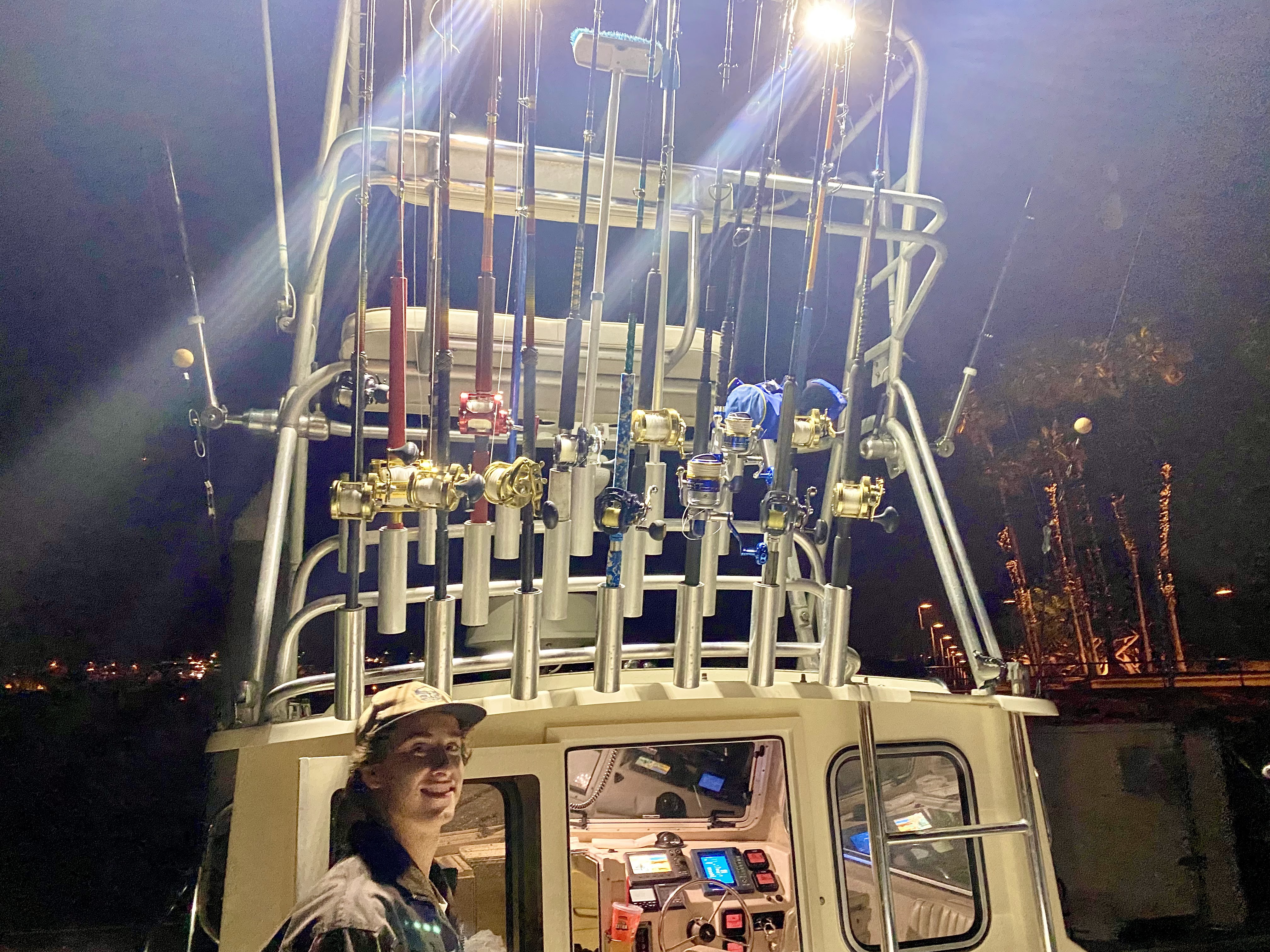
We were targeting the dorado that had been in such tremendous historical abundance, but also  intended to drag for bluefin on heavy gear if we got the chance away from the clouds of boats certain to be with us.  We  each packed 20 pound rigs with 20# fluro; 30 pound fluro tipped medium bait rods; a couple of 40 pounders and heavy trollers.  This necessitated festooning the rocket launchers to capacity.

David paused beneath this display of piscatorial firepower spangling back the glare of the deck lights, adding to the Romance of the Sea ambiance that accompanies midnight departures.

 We dropped a Benjamin on a couple scoops of medium-sized sardines at the San Pedro Bait barge and were on our way back down towards Dana by 2 am.

Our goal was to roll down to the 279 area before gray light and then fan out from the fleet to find a paddy that was holding mahi.  We anticipated grumpy seas and so made better time with smoother water that allowed us to be on station early and loitering in the darkness at 4 am.

The ride afforded Tommy an opportunity to resume the sleep that was briefly interrupted by having to get out of bed and sleep in the car on the way up the coast to Pedro.  He was able to get right to sleep in the v berth after we got bait and headed into the open sea.

The sky was mostly overcast, with the moon partially visible.  It was T-shirt weather, even at this hour, though the heat-lock that had fevered up the state for weeks had finally broken.

We saw the lights of other boats and expected that a vast fleet would be revealed as darkness began to give way to gray, like the bunker view from Normandy on D-Day.

Instead, by the time we began to perceive the horizon, there were only a couple of boats in sight.  Had we somehow gotten separated from the herd?  Was that a bad thing or a good thing?

The Tomahawk and the Truline were the only boats in our area and they soon left after drifting a few dry paddies, just like we did.

As we mosied away from the only boats in sight, we found many worthy paddies to investigate in the 70 plus degree water.  Tommy and David, armed with binoculars and a walkie-talkie connection to the wheelhouse, were our young-eyed scouts in the tower.

The area we concentrated on was at the margin of the big eastern cloud cover.  After an hour or two of baiting promising spots that did not deliver biters, the boys spotted one that was a floating hotel, complete with standing birds.

We threw bait and fish flashed and jumped.  The boys and I started with our lightest 20 pound rigs and #1 circle hooks to provide the best chance if the fish were choosy. 

David got bit, as a dorado screamed of line and was airborne by the time he started to put an arc in the rod. 

Then your narrator hooked up on a bull that made a huge run as David's mahi jumped near the boat and broke off.

 Skipper hooked up and handed off to David so he could gaff my bull dorado as it came to color after a some acrobatics and deep runs that caused me to trade up to my Excalibur Truline and 30 pound line after this stop.


Skipper put your correspondent on the first dead fish with a perfect head shot with the gaff I made for him as David stayed busy with his own fish.

Skipper stayed busy with the gaff as David pumped in his dorado.


These fish are not easy to hit with the hook as they change direction on a dime at the rail.

David was on the board with this specimen.


We drifted well off the kelp and Tommy got lit up again. 

We saw several jumpers and free swimmers around us as they milled about on a pretty elliptical gyre.

Tommy arched back and took his fish toward the corner. Several of these colorful fish won their freedom with boatside acrobatics and gaff dodging maneuvers, but not this one.

The slightly larger bulls tended to go deep and nod hard, like yellowtail, after a couple of surface runs.  

The hens tended to stay on the top and really twisted and spun away from the gaff at the rail, so a quick stick across the back was the ticket.

We kept rolling back up to the kelp and getting bit, not always right away and not always that close to the kelp.

The fish were all good sized, ranging mostly in the 13-17 pound range.  This one caught by your reporter had a fresh gaff hole in the back, as Skipper made a perfect head shot on a fish that was caught after its second and more fatal mistake of the week.  

The boys pulled on a double in the corner.

Over the next couple hours, we pulled limits of really nice fish and decided to push toward the 181.  

Initially, we trolled a few assorted cedar plugs and small tuna feathers at 7 knots while trying out Skipper's new outriggers.  After a while, Skipper and I decided to break out the heavy artillery we were dying to use and drag the hi-speed Nomads in the hope of a blind strike from a bluefin while looking for paddies at 12-13 knots.  This is really hauling ass for trolling and allowed us to cover a lot of ground with the scouts in the tower.

The downside to this program is that the lures are generally a thousand feet behind the boat to account for the wake-shy tastes of bluefin.  Fortunately for us, there were hardly any other boats anywhere to cut across our line, despite the fact that we were hitting pretty generic water.

Each time we saw a promising paddy, we had to grind in our lures like winch monkeys and plot our drift with the bait gear.  We hit some paddies that were absolutely mouth-watering, but did not produce.  

Skipper did pull one more off a paddy.  We did not stay because we had tuna fever, so it was once again back out with the two big rigs.  Skipper had his International 50 on the port and I put out my Tiagra 50 wide on starboard, with 200 pound mono backed by 200 pound spectra.  We fondly refer to it as The Pig.

David was asleep in the v-berth and Tommy was sleep-scouting in the tower when a gust of wind took Tommy's Allgire Foundation fishing hat off his head, causing him to reach back in vain as it blew into the sea near the 312.  As he began to sound the Hat Overboard! alarm, the Pig began to grunt the low frequency siren of its clicker.  We had specifically set the drag to very light tension, so the line raced off the spool as the boat remained in gear.

I got on the handle and brought the drag lever into increasing tension as the fish began to slow.  We all wanted it to be a bluefin, so I went through the exercise of verbally exorcising every other alternative fish, hat, or clump of kelp that could account for the line coming off the reel.  

Soon the line stopped  going out and the rod tip lost some of its tension.  I started turning the handle furiously and it seemed our prey had either freed itself or was coming right at us.

I assumed the latter and kept winding furiously as the line came tight again and the fish took another short run.  Skipper kept the fish away from the boat and had to accelerate to keep the fish from passing us on the starboard.  

We got ahead of it and it started to go from one side of the motors to the other as I fought it stand-up style to keep the line away from the props.  The fish started coming to the boat steadily as the rod provided lift and the reel inexorably dragged him closer.  Skipper kept him away from the props with some matador steering as we arced away from his attempts to cross below us.  Soon he started to pinwheel in nice circles as we kept his head up and spiralling toward the surface.  He was no match for this machinery.

We pegged the 12 foot leader as Skipper put it into neutral and got into the stern for a shot with the gaff made just for this occasion.  With Tommy filming from the tower, your reporter grabbed the line to pull the last six feet into range as the tuna spun up next to the rail.  Skipper stuck it in the pectoral as it gushed red.  David came in from the other side with a second gaff and the two of them heaved it over the rail.  It hit the deck with a very satisfying thump as we screamed like chimpanzees.  We have a video, but I am too lame to include it in this report.


We bled it, gutted it through the head and took out the gills before ramming an ice bag to replace its guts and start cooling it off in the kill bag with all of the stiff, cold dorado and rock salted ice.

We turned toward home and put out the trollers, knowing we had our work cut out for us to clean all these fish and make it to Pedro by midnight. The water got steadily warmer, climbing to nearly 74 degrees by the time we got to the backside of Catalina. We stopped off at some paddies, but were mostly trying to make it to the lee of Catalina to start cutting fish before dark.  We pulled into a cove short of Long Point and Skipper began the wet work with a knife whose blade grew as weary of the cleaving as Tommy did trying to stand up and watch.


It was well into the dark of night when the boys hoisted the tuna for Skipper to start  carefully carving with the fresh knife he had saved for butchering this incredible gift from Poseidon.

This trip was reminiscent of another memorable day that Skipper brought us five years ago.  He sent me the picture below to remind me of the occasion and chart the growth of our young crewmen.

                                                                August 16, 2022

Tommy and David once again proved to be our lucky charms as we found a way to rival one of the best angling days of their young lives, and of our old ones.

We spent a couple hours cutting our catch and then cleaning up the boat when we nosed into Pedro.  We drove home after picking up more ice and staggered into the house around 1 am before crashing hard after a 25 hour tour.  It was like Gilligan's Island grad school.

 The past five years have presented some of the most amazing fishing opportunities in local waters in my nearly 60 years (gulp) of fishing and paying attention to what we could catch in our lifetimes and what Zane Grey wrote about catching 100 years ago.

It is as good as it gets right now, so make your own luck, trade your hat to the ocean for a tuna and turn that handle while you are above ground, because

These are the Days